
Injection molding vs extrusion molding
Both extrusion and injection molding are common silicone products production processes. However, there are significant differences between the two methods pertaining to the process fundamentals, compatibility, strength, and precision. All these factors combine to affect the overall cost and time of the process, which in turn affects the overall costs and capabilities of both methods.
During the development of silicone products, the choice of molding process directly influences structural design, dimensional accuracy, surface quality, production efficiency, mold investment, and the total procurement cost.
- Injection Molding: This process involves injecting a flowable material into a mold cavity, where it is shaped and subsequently cured or cooled to produce a part with a specific geometry. It is well-suited for products with complex structures, intricate three-dimensional shapes, fine details, or those requiring stable, high-volume production.
- Extrusion Molding: In this process, material is continuously pushed through a die with a specific cross-sectional shape to create a product of continuous length, which then undergoes vulcanization, cooling, hauling, and cutting to the required length. This method is ideal for products with a consistent cross-section that require continuous production.
This article focuses on the application of these processes within the silicone industry. Silicone injection molding typically refers to Liquid Silicone Rubber (LSR) injection molding, though it can also encompass injection processes for solid (high-consistency) silicone rubber, provided the appropriate equipment and molds are used. Silicone extrusion generally utilizes compounded silicone rubber specifically formulated for extrusion processing. Neither process should be simply equated to the molding methods used for thermoplastics.
For a silicone product manufacturer, a truly professional approach to process selection goes beyond merely asking whether injection molding or extrusion molding is “better.” Instead, it requires determining which process is most appropriate based on the product’s geometric structure, material system, quality requirements, order volume, and the total lifecycle cost of the project.
What is Injection Molding?
Injection molding is a manufacturing process in which silicone material is delivered into a mold cavity, where it is shaped and vulcanized.
Taking liquid silicone rubber (LSR) as an example, the material—typically consisting of two components, A and B—is metered, mixed, and injected into a heated mold. Through a cross-linking reaction, it then forms a silicone part with a predetermined shape and set of properties. This process differs from the injection molding of thermoplastics; LSR cures within a heated mold, rather than taking shape through the cooling of molten plastic.
Injection molding is well-suited for manufacturing:
- Silicone parts with three-dimensional structures.
- Products featuring snap-fits, bosses, grooves, or localized thin-walled sections.
- Products requiring fine surface textures, brand logos, or specific aesthetic finishes.
- Parts intended for multi-cavity production or automated mass manufacturing.
- Overmolded products—where silicone is bonded to substrates such as plastic or metal—provided that the materials, surface treatments, and molding strategies have been properly validated.
Examples of items that may be produced via injection molding include silicone beauty tools, protective accessories for electronic devices, industrial seals, valve components, and certain infant feeding products. Whether this process is appropriate for a specific application depends on the material grade, product design, performance requirements, and available production equipment.
What is Extrusion Molding?
Extrusion molding is a manufacturing process in which processable silicone rubber compound is continuously fed through a die with a specific cross-sectional shape. The material then undergoes vulcanization, cooling, and hauling (pulling) to produce continuous lengths of finished product.
While the extrusion die primarily determines the product’s cross-section, factors such as hauling speed, vulcanization conditions, and subsequent cutting operations collectively influence the dimensions and quality of the final product.
Extrusion molding is suitable for manufacturing:
- Silicone tubing
- Silicone seals
- Silicone gaskets (or gasket profiles)
- Silicone cords (solid, round-profile cords)
- Silicone strips
- Silicone profiles (custom cross-sectional shapes)
- Certain multi-lumen (multi-channel) tubes, foamed profiles, and co-extruded products.
The core advantage of this process is continuous production. For applications requiring long, continuous runs—such as hundreds of meters of silicone sealing strips—extrusion is generally a more practical and efficient solution than designing the components as individual, discrete parts produced via injection molding.
It should be noted that extruded products typically require a consistent cross-section along their entire length. If a product features significant dimensional variations, localized protrusions, closed ends, or complex three-dimensional structures, additional processing or the integration of other molding techniques is usually required.
Injection Molding VS Extrusion Molding
- Injection molding is suitable for three-dimensional product manufacturing whereas extrusion molding is only suitable for two-dimensional product manufacturing.
- Injection molding is the oldest silicone manufacturing process whereas extrusion is comparatively new.
- Atypical cross-sections can be achieved by extrusion. However, injection molding may demand intricate dies to achieve the same.
- Injection molding offers strength to products, whereas extruded products are comparatively weaker.
- Injection molding is considered expensive due to costly die requirements. Yet this process is the most utilized due to its efficiency.

How are silicone injection molding and extrusion molding carried produced?

Custom LSR(Liquid Silicone Rubber) Injection Molding Service
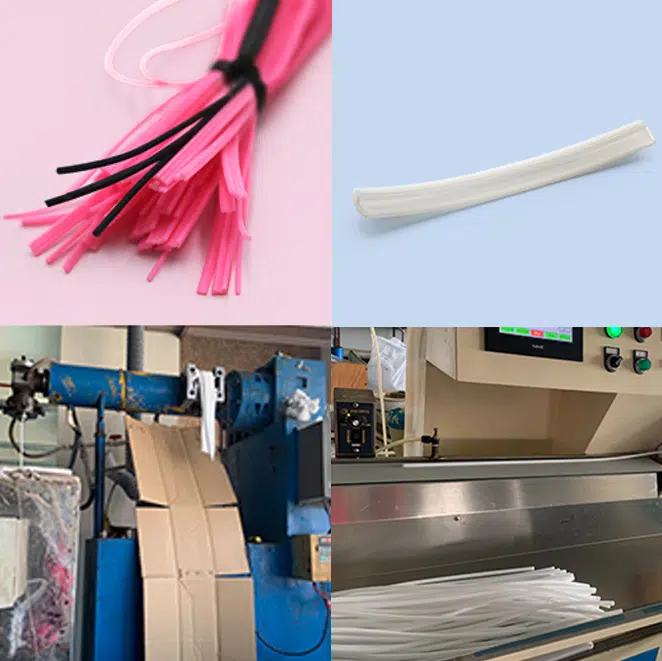
Custom Silicone Extrusion Molding Service
There is a significant difference between injection molding and extrusion when it comes to cost. Injection molding is generally more expensive and most of it is because of the mold costs. The mold needs to be either machined or 3D printed depending on the design’s complexity.
Furthermore, the material also plays a significant part in determining the cost of injection mold. The better the material, the longer will the mold last but that will come at a cost. Injection mold typically has a higher, initial design cost due to the complexity of the mold structure. Its cyclical production, however, typically creates a finished piece that often does not require further assembly or secondary processing.
The extrusion process, on the other hand, is much simpler and handles 2D shapes without any intricacies. As a result, the operating costs of the process are lower but remain unaffected by economies of scale. Moreover, the overall setup costs for extrusion can be quite high considering the restriction on complex designs.
The EXTRUSION method can create complex cross-sections such as multi-lumen tubing used in medical devices or food processing. The surfaces of extruded materials are smooth and do not require post-production “clean-up.” Extrusion is ideal when a variety of lengths of the same profile shape is required. By producing a stock product with a continuous production process and cutting to length post-process per demand, setup and die/design costs are reduced for similar items.
Both injection molding and extrusion work well with silicone. However, injection molding is more suitable for complex closed 3D shapes, like vehicle interior room components. These silicone components have a complex initial dye which significantly increases the capital costs but remains operational for many cycles.
When should you choose injection molding, and when should you choose extrusion molding?
Consider injection molding:
- The product features a complex 3D geometry.
- It includes localized protrusions, slots, mounting holes, or structures requiring precise fit.
- High-volume, consistent production of individual parts is required.
- The product incorporates multiple structural features that must be formed within a single mold.
- Overmolding (encapsulation) processes are required to bond different materials together.
Consider extrusion molding :
- The product’s cross-section remains essentially constant along its entire length.
- Continuous lengths of tubing, strips, cords, or profiles are required.
- The final product length can be cut to size after production.
- The project requires continuous supply, coil/spool packaging, or procurement by the meter.
- The design can be realized through die-forming, pulling (haul-off), and vulcanization processes.
For products with simpler structures, limited order quantities, or items such as large flat sheets or gaskets, a third option should be considered: compression molding. This is not merely a compromise between injection molding and extrusion, but rather a distinct manufacturing route with its own unique cost structure and design advantages.
How do you choose the most suitable molding process?
Step 1: Evaluate Product Geometry
Does the product feature a consistent cross-section along its length? If so, consider extrusion as the primary option. If it is a discrete part with a complex 3D structure, prioritize injection or compression molding.
Step 2: Define the Material System
Determine whether the application requires liquid silicone rubber (LSR), solid (heat-cured) silicone rubber, or a specialized material with specific properties. Different compounds vary in terms of flow characteristics, curing methods, and equipment requirements.
Step 3: Establish Critical Dimensions and Tolerances
Avoid vague terms like “high precision.” Instead, clearly specify critical dimensions, measurement locations, allowable deviations, fit requirements, and inspection methods.
Step 4: Determine Order Quantity and Delivery Format
Products purchased by the meter, roll, or in continuous lengths are typically well-suited for extrusion, while complex, discrete parts are generally better suited for injection molding. For small-batch projects, consider alternatives such as compression molding.
Step 5: Assess Assembly and Post-Processing
If the product requires overmolding, inserts, end-sealing, connectors, or secondary processing, incorporate these operations into the overall cost and reliability assessment.
Step 6: Validate via Prototyping Before Committing to Mass Production
Verify that the design and production approach meet all requirements—using samples, dimensional reports, functional testing, and necessary durability testing—before finalizing the mass production plan.
Summary:
Injection molding and extrusion molding are both essential manufacturing processes for silicone products, though they cater to different product structures and production requirements.
- Injection molding: Best suited for complex 3D parts, intricate structural details, functional designs, and standalone products that require consistent, high-volume production.
- Extrusion molding: Ideal for continuous products such as silicone tubing, sealing strips, cords, profiles, and other items with a constant cross-section.
- Compression molding: A viable alternative to consider for silicone products that feature simpler structures, larger dimensions, or moderate production volumes.
For buyers, the “best” manufacturing process is not necessarily the one with the most advanced equipment, the lowest unit price, or the most sophisticated appearance; rather, it is the process that effectively meets the product’s functional, quality, lead-time, and lifecycle cost requirements.
For silicone OEM/ODM manufacturers, true competitiveness lies not just in production equipment, but in the ability to identify manufacturing risks early in a project, provide sound process recommendations, implement robust quality control, and guide clients seamlessly from sample development to stable, full-scale production.
Before requesting a formal quote or initiating mold tooling, it is advisable to address three key questions: What is the product’s structure? What are the critical quality requirements? What is the projected procurement volume? The answers to these questions will typically help the engineering team quickly narrow down the most suitable manufacturing processes.
FAQ:
Q1: What is the primary difference between injection molding and extrusion molding?
Injection molding is typically used to manufacture discrete parts with specific three-dimensional shapes, whereas extrusion molding is generally used to produce continuous products with a largely constant cross-section. The choice between the two should be based primarily on the product’s geometry and its final delivered form.
Q2: Which process offers a faster production rate?
The two processes are measured for production efficiency in different ways. Injection molding is usually evaluated by the number of acceptable parts produced per mold cycle or per hour, while extrusion molding is typically measured by the length of acceptable product produced per minute or per hour.
For continuous profiles, extrusion generally holds a clear advantage; for complex three-dimensional parts, injection molding is better suited to the structural requirements. It is not possible to compare speeds directly without considering the specific product.
Q3: Which process is more cost-effective?
There is no single answer. Extrusion molding is generally more economical for products with a continuous cross-section, while injection molding may be more appropriate for complex, discrete parts that require consistent, high-volume production. A cost comparison should account for tooling, materials, equipment, post-processing, and quality-related expenses.
Q4: Can injection molding be used to produce long, strip-like silicone products?
It is possible to manufacture certain long, discrete parts; however, if the product’s cross-section remains largely constant along its length and a continuous length is required, extrusion molding is usually the preferred option to evaluate first.
Q5: Can extrusion molding produce complex three-dimensional structures?
The primary limitation of standard extrusion is that the cross-section must generally remain consistent along the entire length. Features such as localized protrusions, closed ends, complex joints, or three-dimensional structures may require secondary processing, assembly, or alternative molding methods.
Q6: Is injection molding inherently more precise than extrusion molding?
Not necessarily. While injection molding is well-suited for controlling the geometric dimensions of complex cavities, the actual outcome depends on factors such as mold precision, material shrinkage, the specific material used, and the molding process itself. Extrusion molding can also achieve precise control over critical cross-sectional dimensions, though one must also account for factors like haul-off (pulling) speed, vulcanization, and potential product deformation.
Decisions should be based on actual technical drawings, specified tolerances, and the results of sample testing.
Q7: Does injection molding always require liquid silicone? Not necessarily. While liquid silicone rubber (LSR) injection molding is a common process, there are also injection molding solutions designed for solid (high-consistency) silicone rubber. The material form, equipment configuration, and processing parameters must all be aligned.
Q8: Can extruded silicone tubing have multiple channels (lumens)?
Yes. Multi-channel silicone tubing can be produced using specially designed dies. However, factors such as channel positioning, wall thickness, dimensional stability, and production complexity must be evaluated based on the specific cross-sectional design.
Q9: Can custom colors be used in both injection molding and extrusion?
Generally, yes. However, the feasibility of specific colors, color consistency, and the impact on material properties must be confirmed by considering the silicone compound formulation, pigment system, and processing method. For branded projects, it is best to provide standard color values (e.g., Pantone codes) or physical color samples in advance, and to agree upon the criteria for color acceptance.
Q10: Can both processes be used to manufacture silicone products for food contact or medical applications?
Both processes can be used for such products, provided that the materials, production processes, and product requirements are appropriate. Whether a product complies with specific regulations or medical-grade requirements depends on its intended end-use, the materials used, testing, and production control systems; it cannot be determined solely by the manufacturing process.
Q11: Can injection molding and extrusion be combined?
Yes. For example, continuously extruded silicone tubing or profiles can undergo secondary operations such as cutting, end-forming, joint assembly, or localized overmolding. The specific combination strategy depends on the product structure, the reliability of the joints, and production costs.
Q12: What information should be provided when requesting a quote from a silicone manufacturer?
It is recommended to provide as much of the following as possible:
- 2D engineering drawings or 3D CAD files.
- Material type, hardness, and color requirements.
- Intended product use, operating environment, and key performance requirements.
- Critical dimensions and allowable tolerances.
- Sample quantities, projected mass production volumes, and annual demand.
- Requirements for packaging, inspection, testing, and delivery.
If complete drawings are not yet available, you may provide product images, dimensional sketches, and a description of the application to allow the supplier to conduct a preliminary manufacturability assessment.

